

Does growing up mean leaving your childhood behind?
& why are we all so upset about it?

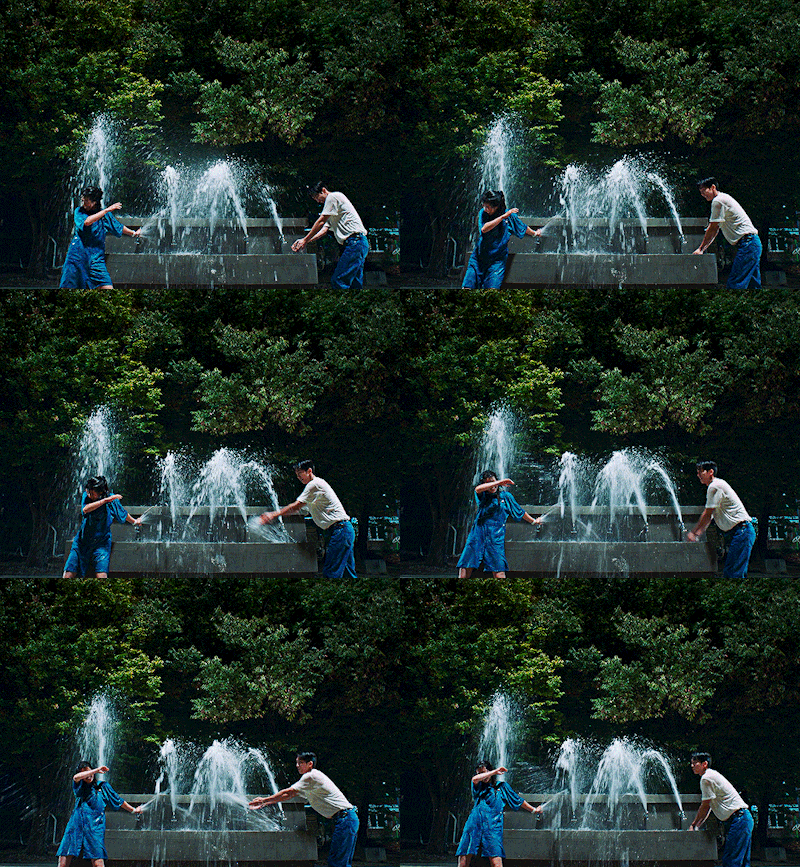
Let’s start this conversation about childhood with a movie scene. The two main characters, Na Hee-Do (an 18yo high school student) and Back Yi-Jin (21yo), promise each other to be happy whenever they spend time together.
Watching the series Twenty-Five Twenty-One on Netflix, there is a scene I cannot stop thinking about. The eighteen-year-old Hee-Do is shown here to be so free, careless, happy, and everything you would think children with big dreams would be. The soundtrack for that scene makes it feel almost unsettling, almost as if I was old enough to reminisce about this moment. Except I am younger than Hee-Do, so what is it about childhood that feels so far away?
“Critics who treat 'adult' as a term of approval, instead of as a merely descriptive term, cannot be adult themselves. To be concerned about being grown up, to admire the grown up because it is grown up, to blush at the suspicion of being childish; these things are the marks of childhood and adolescence. And in childhood and adolescence they are, in moderation, healthy symptoms. Young things ought to want to grow. But to carry on into middle life or even into early manhood this concern about being adult is a mark of really arrested development. When I was ten, I read fairy tales in secret and would have been ashamed if I had been found doing so. Now that I am fifty I read them openly. When I became a man I put away childish things, including the fear of childishness and the desire to be very grown up.” ― C.S. Lewis
While childhood is not a brand new phenomenon, it had a beginning, too - just like our obsession with dividing clothes for genders and a variety of other things. Philippe Ariès, a french historian of childhood and family (who knew you could get this smitten with the subject!), was one of the first to argue that childhood was a modern concept - he goes as far as calling what is happening now a ‘modern cult of childhood.’ Sociologists are not arguing that kids did not exist, but they are saying that what we associate with childhood - rights, responsibilities, restrictions, age - could be, in part, a social construct. It wasn’t until around the 13th century that we started to paint children differently than adults, dress them differently, and significantly distinguish between the things for kids and those for adults.
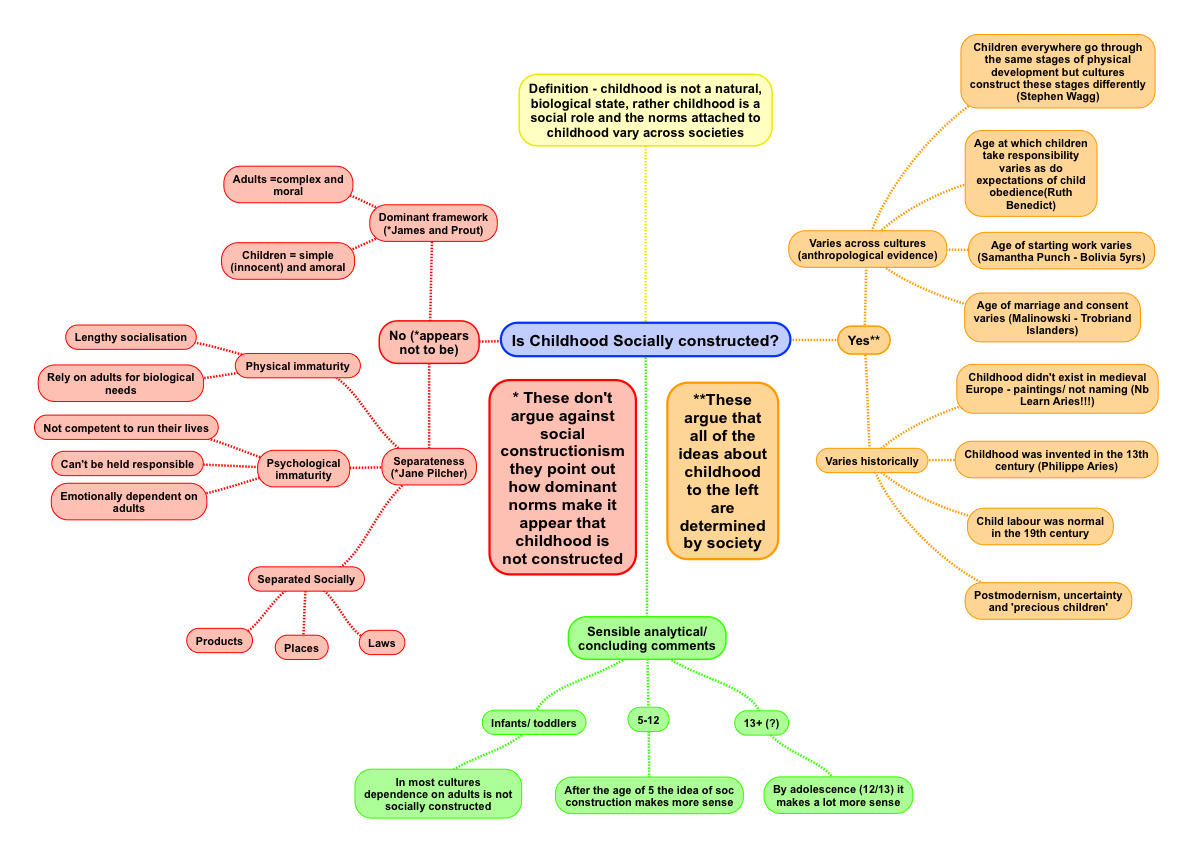
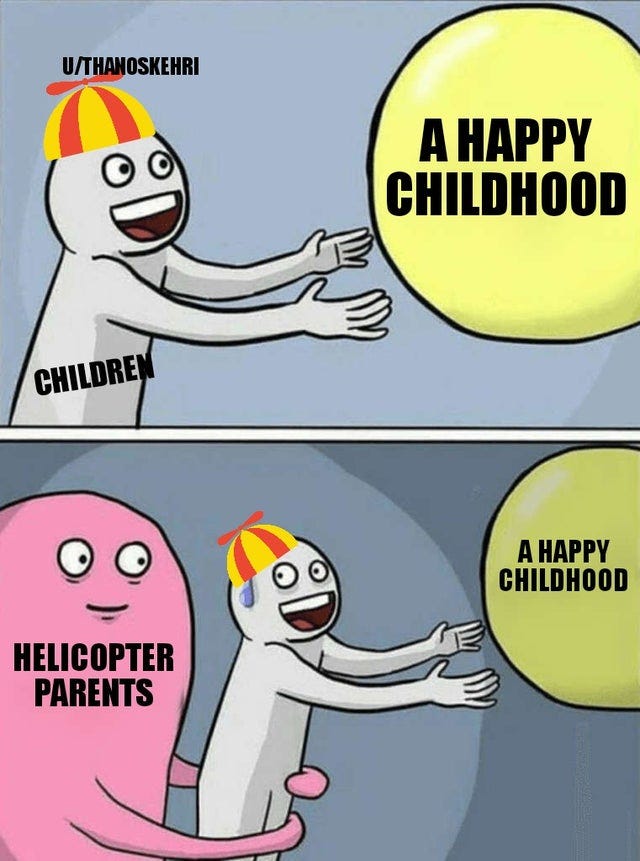
Nowadays, if you Google childhood, you are sure to get all the guidelines on what it should be like and what you should be experiencing, and at what age your kid is supposed to be reading or writing or putting on their socks (we even have downloadable sock fact sheets now). The first thing that comes up when you ask the ever-expanding web about 21st-century childhood is a warning about “helicopter parents,” and if you don’t know who they are, you are one of the lucky ones.
For one, I think that this huge distinction between “adulting” and things you are supposed to be doing as a child makes the transition more visible to us. This could be the social construct part of childhood that exacerbates feelings of “losing” a part of our life. There are apps to help you transition, with tips on how to cook and fix a sink, unclog a toilet (I used that tutorial recently, it was fun), and all kinds of meal prep golden rules. All of this feels like a tutorial for living a different life, which I don’t believe is what growing up is. Isn’t it just supposed to make sense? Aren’t we growing up step by step, so we don’t need to be studying for this like an exam? Not everyone gets to take their time to learn these things, but for most of us, I don’t think we should be stressed. We overestimate how much further ahead from us others are all the time anyway.
“I started living alone, vacuuming my apartment weekly, saving parmesan rinds for soup, calling to negotiate better rates for utilities. I became a better cook and friend, especially to myself. These specific tasks are not meant to demonstrate adulthood, the inane fantasy of the unrigorous that there is a finite level—based often on what you can afford to own and what that implies—at which no further acquisition of skills or growth is necessary. Rather, it’s to illustrate that I now live my life in a way that suggests I care to be in it. Naturally that desire transfers to other tasks, practices, and ways of relating––what I mean is that it transfers to love.” — Lucy Morris
Two, everyone gets so upset about growing up — whenever you look, it seems like it is supposed to be this big, hard thing to go through that suddenly depletes us of happiness and drains us of every drop of creativity. I’m sure you’ve at least once heard the phrase, “and then I grew up,” followed by some sappy realization that the world is not as rose-colored as everyone wants it to be. And it technically makes sense that we are supposed to get less creative and fit in more, but I refuse to believe that it must be so sad and entirely true. Sure, taxes and paying off debt, getting a house, having a family, working an actual job, managing your money, and deciding what you do with your time. On the other hand, this is a beautiful opportunity to do things your way. Is it not incredible that you can choose when to leave and go to the bathroom without asking once you are out of high school? And now you can choose exactly what you want to eat and only have to eat what you buy? And you can do things alone, pretty much anytime, without anyone questioning where you are going or why you are using your time a certain way? Wasting time is a weird cultural concept, anyway.
The worst thing that can happen in this whole childhood turmoil, whether related to being scared of adulting or not being a child (because, recognize, those are two entirely different things), is losing your childhood self. There are many benefits to returning to something you “used to love” or “did as a kid.” The internet is filled with things people wish they could do.
But they can. You can play with Lego again, if you want to, instead of watching a new TV show you are not interested in. You can even run to your neighbors, make friends, and spend the evening together playing board games. You can climb trees - for the most part, there is no one to tell you not to. You literally can. And it’s trendy, too, with all the talk about romanticizing life recently. I find it very satisfying doing these things that I am not supposed to be doing because I am all grown up now (like painting with my hands), and that may be one of the most childish things about me.
“I do not miss childhood, but I miss the way I took pleasure in small things, even as greater things crumbled. I could not control the world I was in, could not walk away from things or people or moments that hurt, but I took joy in the things that made me happy.” ― Neil Gaiman, The Ocean at the End of the Lane
I grew up reading Gaiman’s children’s books (there you go, another example, we have books for kids, too) - including one of my favorites, “Fortunately, the Milk….” Luckily, as an adult, you are allowed to read whatever books you want. Maybe I will re-read “Fortunately, the Milk….”
Art
Music
“It's all on the surface
It don't hurt anymore
I've been talking to you
Skipping rocks by the shore
Am I the perfect picture
That you wanted before?
I'm not quite sure”
What better way to celebrate the theme of this letter than with a nostalgic pop song? A perfect blend between happy & sad; I’ve listened to this song way too much throughout September.
Ideas
Award-winning painter, Georgia O'Keefe, suggests optimizing for your interests rather than your happiness: "I do not like the idea of happiness — it is too momentary. I would say that I was always busy and interested in something — interest has more meaning to me than the idea of happiness."
Source: The Complete Correspondence of Georgia O’Keeffe & Anita Pollitzer
Books

I read “A Little Life” by Hanya Yanagihara a little while ago, but I am still thinking about it. It is really, really, really sad, but it will make you feel like you have known the characters forever. After 720 pages, I still didn’t have enough of the story.
The book makes excellent use of analogies all over the place and gives insights into how relationships change and what they mean to us as we live our life. It is also the book you will have to put down to process every once in a while.
“The axiom of equality states that x always equals x: it assumes that if you have a conceptual thing named x, that it must always be equivalent to itself, that it has a uniqueness about it, that it is in possession of something so irreducible that we must assume it is absolutely, unchangeably equivalent to itself for all time, that its very elementalness can never be altered. But it is impossible to prove. Always, absolutes, nevers: these are the words, as much as numbers, that make up the world of mathematics. Not everyone liked the axiom of equality––Dr. Li had once called it coy and twee, a fan dance of an axiom––but he had always appreciated how elusive it was, how the beauty of the equation itself would always be frustrated by the attempts to prove it. It was the kind of axiom that could drive you mad, that could consume you, that could easily become an entire life.
But now he knows for certain how true the axiom is, because he himself––his very life––has proven it. The person I was will always be the person I am, he realizes. The context may have changed: he may be in this apartment, and he may have a job that he enjoys and that pays him well, and he may have parents and friends he loves. He may be respected; in court, he may even be feared. But fundamentally, he is the same person, a person who inspires disgust, a person meant to be hated.”
― Hanya Yanagihara, A Little Life“Harold sighs. “Jude,” he says, “there’s not an expiration date on needing help, or needing people. You don’t get to a certain age and it stops.”
― Hanya Yanagihara, A Little Life
That is the newsletter. I hope to see you here next time and hear feedback, thoughts, and requests from you in the meantime. Hit reply and let me know what you thought about this entry, recommend a song, or write me a letter…
Signing off,
Zuza